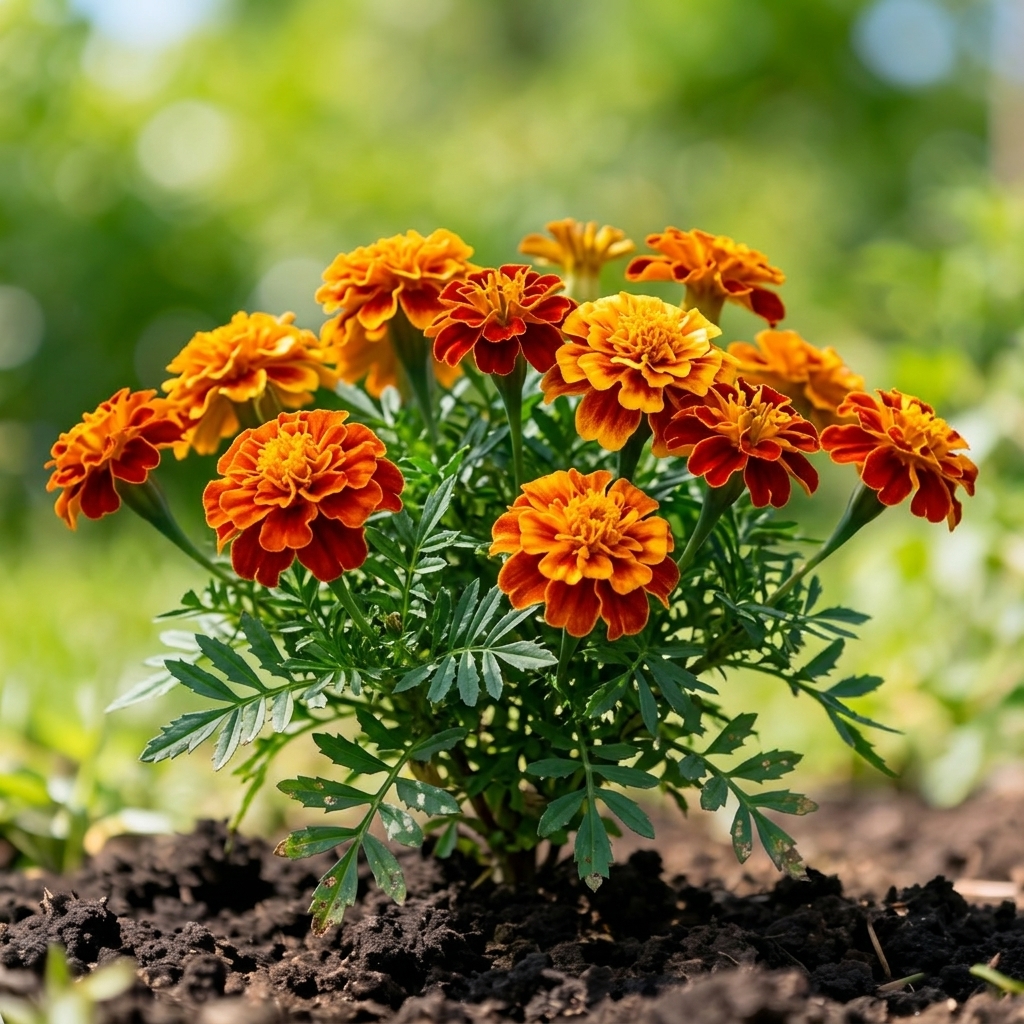
Œillet D'Inde
Tagetes patula nana
Fleurs dorées comestibles, répulsif naturel pour le potager.- Riche en lutéine et zéaxanthine, précieux pour la santé des yeux
- Propriétés antiseptiques et anti-inflammatoires reconnues en phytothérapie
- Répulsif naturel des nématodes, favorise la biodiversité du potager

certifiées bio

Pays-Bas

Profil de la plante

Calendrier de culture




Conseils de culture
Semis et germination de l'œillet d'Inde nain
L'œillet d'Inde nain (Tagetes patula nana) est une des plantes les plus faciles à semer et à cultiver au potager ou sur le balcon. Le semis se réalise en intérieur à partir de fin mars, dans un substrat léger et bien drainé à une température de 18 à 22 °C. Les graines germent très rapidement, en 5 à 7 jours, sans nécessiter de prétraitement particulier. Semez les graines à 5 mm de profondeur, espacées de 2 cm, dans des caissettes de semis remplies d'un mélange de terreau et de sable (80/20). Maintenez le substrat légèrement humide en évitant la saturation hydrique. Pas besoin d'obscurité : les graines germent indifféremment à la lumière ou dans le noir.
Développement du jeune plant et repiquage
La croissance des jeunes plants est vigoureuse et rapide. Dès l'apparition des deux premières vraies feuilles (généralement 2 semaines après la levée), repiquez les plants dans des godets individuels de 8 cm remplis de terreau universel. Les plants supportent bien le repiquage à condition de manipuler délicatement les racines encore fragiles. Exposez-les progressivement au soleil et au vent pendant 7 à 10 jours avant la mise en pleine terre après les saints de glace (mi-mai). Cette plante rustique et sans prétention s'adapte à tous les types de sol et récompense généreusement le jardinier par sa floraison abondante tout au long de l'été.
- Température : 18-22°C pour une germination rapide en 5-7 jours
- Humidité : Substrat légèrement humide, bonne aération
- Lumière : Lumière normale, pas d'exigence particulière à la germination
- Repiquage : 2 vraies feuilles, 2 semaines après levée
Points clés
- Température : 18-22°C, germination rapide en 5-7 jours
- Humidité : Substrat légèrement humide
- Lumière : Sans exigence particulière à la germination
- Repiquage : 2 vraies feuilles, environ 2 semaines
Plantation de l'œillet d'Inde au jardin et au potager
L'œillet d'Inde se plante en pleine terre ou en bac après les dernières gelées, à partir de mi-mai. Il s'adapte à tous les types de sol, même pauvres, à condition que la perméabilité soit satisfaisante. Choisissez un emplacement ensoleillé à semi-ombragé, idéalement en association avec des tomates, des poivrons ou des aubergines pour lesquels il agit comme répulsif naturel de nématodes et de certains insectes nuisibles. Préparez légèrement le sol en le décompactant sur 10 à 15 cm et en incorporant un peu de compost pour nourrir les premières semaines. Un sol trop riche en azote favorise le développement foliaire au détriment de la floraison – ne surfertilisez pas.
Mise en place et association au potager
Plantez en quinconce avec un espacement de 20 à 25 cm entre plants pour obtenir un effet de masse coloré. En bordure de potager, des rangées d'œillets d'Inde créent une barrière répulsive efficace contre les nématodes du sol et les pucerons. L'arrosage d'installation doit être modéré : cette plante est naturellement tolérante à la sécheresse une fois bien installée. Un paillage léger autour des pieds réduit les arrosages et maintient la fraîcheur du sol. Contrairement à beaucoup d'annuelles, l'œillet d'Inde n'exige ni tuteurage ni pincage – il se ramifie naturellement et produit des fleurs en continu.
- Profondeur : Collet au niveau du sol
- Espacement : 20-25 cm entre plants, idéal en quinconce
- Arrosage : Modéré à l'installation, puis très économe en eau
- Association : Idéal en bordure de tomates, poivrons, aubergines
Points clés
- Profondeur : Collet au niveau du sol
- Espacement : 20-25 cm, en quinconce
- Arrosage : Modéré à l'installation puis très peu
- Association : Tomates, poivrons, aubergines (répulsif naturel)
Entretien minimal de l'œillet d'Inde
L'œillet d'Inde est une plante d'entretien quasi-nul qui se contente d'un minimum de soins pour produire des fleurs en abondance tout l'été. L'opération la plus bénéfique est le défleurage régulier (suppression des fleurs fanées) qui stimule la production de nouveaux boutons floraux et prolonge la saison de floraison jusqu'aux premières gelées. Arrosez uniquement par temps de sécheresse prolongée : cette plante d'origine mexicaine est remarquablement résistante au manque d'eau. Évitez les apports d'engrais azotés qui produiraient un feuillage luxuriant aux dépens de la floraison. Un simple binage occasionnel autour des pieds suffit pour l'entretien du sol.
Résistance naturelle et rôle écologique au potager
L'œillet d'Inde libère des thiophènes par ses racines, des composés toxiques pour les nématodes phytoparasites qui s'attaquent aux légumes cultivés à proximité. Cette propriété fait de lui un compagnon inestimable au potager biologique. Il attire également les insectes pollinisateurs et certains insectes prédateurs utiles comme les syrphes qui consomment les pucerons. Très résistant aux maladies et aux ravageurs, il nécessite rarement une intervention sanitaire. En fin de saison, laissez quelques fleurs monter en graine pour assurer une ressemis naturel l'année suivante ou pour récolter les graines.
- Type de sol : Tout type, même pauvre, bien drainé, pH 5,5-7,5
- Entretien : Défleurage régulier, pas de fertilisation azotée
- Arrosage : Très économe, seulement en cas de sécheresse prolongée
- Action préventive : Répulsif naturel nématodes, attire pollinisateurs
Points clés
- Type de sol : Tout type, bien drainé, pH 5,5-7,5
- Entretien : Défleurage régulier des fleurs fanées
- Arrosage : Très faible, seulement en sécheresse
- Action préventive : Répulsif naturel nématodes et pucerons
Récolte des fleurs et production de graines
Les fleurs de l'œillet d'Inde se récoltent dès leur pleine ouverture pour un usage culinaire ou décoratif. Cueillez de préférence le matin après l'évaporation de la rosée, en sectionnant la tige juste en dessous de la fleur. Pour la récolte des graines, laissez quelques fleurs monter en graine en fin de saison (septembre-octobre) jusqu'à ce que les akènes soient bien secs et brunâtres. La tête florale fanée doit être sèche et les graines faciles à détacher. Conservez les graines récoltées dans une enveloppe papier étiquetée dans un endroit sec et frais pour un semis l'année suivante. La floraison continue pendant toute la saison chaude – de juin jusqu'aux premières gelées – assure une récolte régulière sans effort.
Conservation et utilisation des fleurs récoltées
Les fleurs fraîches se conservent 3 à 5 jours dans un vase d'eau froide. Pour un usage culinaire, séparez les pétales de la partie verte amère et utilisez-les immédiatement. Le séchage à l'air libre ou au déshydrateur à basse température permet de conserver les fleurs entières ou les pétales plusieurs mois. L'infusion de fleurs séchées dans une huile neutre produit une belle huile dorée aux propriétés antiseptiques légères. Pour la préparation d'un vinaigre aromatisé aux fleurs d'œillet d'Inde, laissez macérer les pétales frais dans du vinaigre de cidre pendant 2 semaines.
- Période : Juin jusqu'aux premières gelées, floraison continue
- Stade : Fleurs à pleine ouverture pour usage frais
- Méthode : Cueillette à la main le matin, défleurage régulier
- Stockage : Vase 3-5 jours, séchage ou congélation des pétales
Points clés
- Période : Juin-premières gelées, floraison continue
- Stade : Pleine ouverture de la fleur
- Méthode : Cueillette manuelle le matin
- Stockage : Vase 3-5 jours, séchage des pétales
Fleurs comestibles et usages en cuisine
Les fleurs d'œillet d'Inde sont comestibles et utilisées en cuisine comme les fleurs de capucine ou de bourrache. Les pétales, séparés de la partie verte légèrement amère, apportent une note légèrement épicée et musquée aux salades, aux risottos et aux plats décorés. Les fleurs entières garnissent joliment les assiettes et buffets. En cuisine asiatique et mexicaine, les fleurs d'œillet d'Inde (appelées cempasúchil au Mexique) servent à la préparation de sauces et d'infusions. Les pétales séchés et réduits en poudre peuvent remplacer le safran comme colorant alimentaire naturel doré dans les riz et les pâtes.
Propriétés médicinales et phytothérapeutiques
L'œillet d'Inde est reconnu en phytothérapie pour ses propriétés antiseptiques, anti-inflammatoires et cicatrisantes. Riche en lutéine et en zéaxanthine, des caroténoïdes précieux pour la santé oculaire, il entre dans la composition de compléments alimentaires spécialisés. L'infusion de fleurs séchées s'utilise traditionnellement contre les troubles digestifs légers. Les extraits de Tagetes patula sont utilisés dans la fabrication de cosmétiques pour leurs propriétés régénérantes et anti-âge. La macération huileuse de fleurs fraîches dans de l'huile de tournesol pendant 3 semaines produit un soin doux pour les peaux sensibles.
- Profil gustatif : Légèrement épicé, musqué, amer si partie verte incluse
- Préparations classiques : Salades fleuries, riz coloré, garnitures décoratives
- Accords gagnants : Fromages frais, salades vertes, desserts, riz safranado
- Conservation : Vase 3-5 jours, séchage ou poudre de pétales
Points clés
- Profil gustatif : Légèrement épicé, musqué, floral
- Préparations classiques : Salades fleuries, riz coloré, décoration
- Accords gagnants : Fromages frais, salades, desserts fruités
- Conservation : Vase court terme ou séchage des pétales